The Broken Enchilada: When the Whole Enchilada Isn’t Whole
I dream of enchiladas. Then someone said there was a whole one. I got worried — what had I been missing?
The Whole Enchilada is a white whale. A unicorn. A mythic, ephemeral creature.
You don’t ever really get the whole thing. But even just a few bites is tasty.
The first time I tried the whole enchilada I got a broken enchilada.
The first thing that broke was my buddy.
Lunch Loops. Grand Junction. A few days before. An unnotable section — slightly uphill, with a stumpy little tree on the downslope side of the trail — the kind of section you ride a hundred times without incident until one time a wheel deflects, an awkward bobble results, and a slow but insistent fall commences that cannot be reversed, only completed. Riders who are six foot four have a long way to go down, whether they flail helplessly or not. Strike of human sternum upon gnarled stub of juniper is a shockingly violent event.
He was alive. He was tough. He was, by every measurable standard, going to be fine.
I was going to ride the Whole Enchilada.
These two facts were, I want to be clear, entirely unrelated.

Here is how the logistics worked out, which is to say here is how I engineered them while maintaining complete plausible deniability as a supportive friend.
I drove the camper van from Grand Junction to Moab. This was generosity. I drove it up Sand Flats Road to the campground. This was also generosity. We set up camp under cloud of his broody mood. This is me dealing with adversity, and I must say I did very well.
The next morning I drove the van up Sand Flats Road to launch our attack on the Whole Enchilada. Inside was me, my bike, and the invalid. At the point of separation I even turned the van around for him, executing a flawless seventeen-point turn on a dirt road while he watched from the passenger seat with a bruised sternum and the expression of a man not yet fully resigned to his lot in life. This was extraordinary generosity and I want it on the record.
Then he said he thought he’d be okay driving it back down Sand Flats Road on his own.
I agreed.
Conveniently.
We were both very brave about it. He gingerly gripped the wheel. I shouldered my pack. We said the things riding partners say when one of them is about to go do the thing and the other one is going to drive a camper van down a dirt road with a bruised sternum and then spend the day at the campground metabolizing expensive groceries and stewing, not necessarily in that order.
I watched him assume command of the van.
I pushed off toward the trail.
Did not look back.
A gentleman knows when not to look back.
Trailforks.comI stood at the top and looked up.
Snow.
Not a dusting. Not a suggestion. A full meteorological declaration that Burro Pass was not happening today, was not happening for several weeks, and please adjust your expectations accordingly.
Here is what Burro Pass is: the highest, most remote, most genuinely savage portion of the Whole Enchilada. The section that separates the people who rode the Whole Enchilada from the people who rode most of it. The section that justifies the name. The section every person who has ridden it mentions first, immediately, before anything else, in the tone of voice people use when they are trying not to seem like they are bragging but they are absolutely bragging.
Here is what Burro Pass was on 21 March 2017: a snow field visible from the trailhead that ended my ambitions before I touched a brake lever.
I stood there looking at the snowline the way you look at a flight departures board when your connection is cancelled — the information is clear, the situation is final, and the grief is entirely disproportionate to the circumstances yet completely valid anyway. A grown man. Standing at a trailhead in Utah. Genuinely bereft about snow.
Burro Pass remains mythic to me. An unmade memory. A flavor I have not tasted. The bite the enchilada kept for itself.
The accessible portion began lower. I pointed the bike at it.
The broken enchilada was going to get eaten whether it wanted to or not.
The upper singletrack ripped.
I want to be precise about this: it ripped. Riding blind — first time on this trail, no local knowledge, no beta beyond what I’d absorbed through years of hearing about it — and it ripped anyway. The kind of riding where the decisions happen below the level of thought, where the body is doing something the brain won’t understand until later, where the trail is giving and you are taking and the whole transaction is conducted in a language older than language.
March in Moab. The La Sals still white. The desert doing that thing it does in early spring where the cold and the clarity combine into something ephemeral and fleeting. The kind of morning that makes you feel briefly, embarrassingly grateful to be alive, which is an emotion grown adults are not supposed to have at nine in the morning on a Tuesday but here we are.
I was having the time of my life on LPS.
My buddy was on Sand Flat Road eating something artisanal.
Then I hit the snotch.
The snotch is a thing that exists on this trail and I am not going to describe it beyond that because some things in mountain biking are known and some things are learned and the snotch is firmly in the second category and the learning of it is part of the experience and also I didn’t want to think about it for very long. I got off the bike. Dragged it down with the calm efficiency of a man accepting a verdict. Back on. Moving. We don’t talk about the snotch.
Let alone anything it rhymes with.
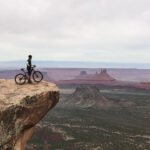
The Porcupine Rim overlook is one of many but it is the one.
You know the one. The rock that juts way out over the canyon like the geology made a decision and committed to it completely, no second thoughts, no safety net, just pure geological confidence cantilevered over several hundred feet of open air. Castle Valley below. The river somewhere. The La Sals behind you. The scale of the American West arranged in every direction like it’s trying to make a point and the point is: you are very small and this is very large and isn’t that something.
I desired a photo.
Now here is where I have to be honest about something.
I did not take a selfie. I am of a certain dignity and that dignity has limits and at that time one of those limits was the selfie. What I did was locate a suitable rock, place my phone on it, engage the self-timer, walk back to my mark at the end of the jutting geological confidence, stand there in the wind above Castle Valley, wait for the beep, arrange my body into something between contemplative and casual which is harder than it sounds, hear the click, walk back to the phone, assess the result, determine it was slightly wrong, walk back to my mark, wait for another beep, arrange the face again, hear the click, walk back to the phone, and accept that one as sufficient.
This process took approximately four minutes.
I was alone on a canyon rim above one of the great landscapes on earth, conducting a solo photo shoot for an audience of zero, walking back and forth between a phone on a rock and a spot at the edge of the void, getting the shot.
He should have been in this photo.
He was on Sand Flat Road. Probably eating a second thing. Burning through it at the cellular level with the thermal efficiency of a very tall furnace. Six foot four people don’t store energy — they convert it immediately and completely into height and metabolism and the ability to walk away from very stumpy and very angry juniper trees with only a bruised sternum, which, the more I thought about it standing on that rock, was frankly impressive.
I looked into the distance.
The canyon looked back.
I took the picture.
The jeep road rewarded aggression and I am an aggressive human.
The correct tactic on Porcupine Rim doubletrack is commitment. You find a line and you hold it far past the point where a sensible person pumps the brakes, because the chunder rewards momentum and punishes hesitation and the whole chaotic beautiful surface of that jeep road is essentially a test of your willingness to stop managing the situation and just ride the thing.
I stopped managing the situation.
I rode the thing.
Specifically I found a straight line through a section of chunder that presented itself as an invitation and I accepted that invitation enthusiastically and at speed, bombing it the way you bomb things when you are alone and there is no one to witness the consequences and therefore the consequences are technically theoretical until they aren’t.
They stopped being theoretical.
The rear tire made its announcement in the way rear tires make announcements when they are done negotiating, which is to say it made no announcement at all — just an immediate, total, non-negotiable conversion from inflated to not inflated, the air departing all at once with the finality of basic physics.
I said things to the tire.
The tire had heard it before.
I flipped the bike. Found the hole — a proper rip, not a slow leak, a wound, the rock had found the weak spot and opened it without ceremony. Bacon strip. Worked the plug in with the tool made for baby hands. Pumped it back up. Five minutes, okay maybe seven, standing on the jeep road in the March sun in front of a raven on a juniper watching with the professional detachment of a journalist who has already filed the story.
My buddy, I calculated, had by now consumed and metabolized an entire wheel of cheese.
I got back on the bike.
Jackass Canyon arrives like a front of weather — sudden, total, non-reversible.
Any semblance of doubletrack vanishes and the trail makes a decision. It narrows to widths of consequence and begins moving toward negative space with the quiet intention of something that has been planning this for a while. The views shift. The stakes clarify: still desert, but steeper. The negotiator: you, on a bike, making choices.
I was moving well. The kind of flow state that feels like borrowed time because it is, the kind where the trail is talking and you are listening and the conversation is going better than you have any right to expect. I was present in the way you can only be present when everything abides and there is no version of the next thirty seconds that allows for thinking about anything else.
I saw the step-down sequence.
Saw the line.
Committed before the decision was conscious.
Missed.
Or came in front-heavy — the precise mechanics remain genuinely unclear to me and I have had eight years to reconstruct them and gotten nowhere. What I know: there was a step-down, there was a line I thought I had, and then there was the ground arriving ahead of schedule, and my right hand doing something that hands are not engineered to do, bending in a direction that caused an immediate and thorough neurological complaint from every relevant system in my body.
I sat in the dirt in Jackass Canyon and took stock.
My buddy, forty-eight hours prior, had folded into a juniper tree on an unnotable section of trail outside Grand Junction and come away with a bruised sternum.
I had just bent my hand sideways on a step-down I was certain I had.
The mountain had collected its parallel toll. I don’t know what cosmic ledger it’s running or who audits the thing but the math was exact — one injury per rider, proportional to the offense, delivered with the impersonal precision of an institution that has been doing this for a very long time. His sternum. My hand. The universe, balanced.
Sympathy injury, I thought. Almost certainly.
I got up. Checked the derailleur — jacked at the hanger, miraculously still shifting. Checked the hand — painful, operational. Assessed the overall situation — ready, committed.
The enchilada had taken its full payment.
Time to finish the thing.

The descent to the Colorado is where Porcupine Rim stops being a trail and becomes a point.
The point is this: here is what you came for. Here is the rock, honest and exact, not groomed, not softened, not apologizing for itself. Here is the canyon. Here is the river down there, getting closer with every turn, three thousand feet below where you started, the whole descent laid out behind you like an invoice you are only too happy to pay in full.
I met the trail as honestly as I could, one braking hand compromised.
So — not always very honestly.
But honestly enough.
The Colorado beckoned. Green and cold and moving at the pace of something that has never once been in a hurry and has no plans to start. I rolled onto flat ground and stopped pedaling and just — stopped.
Helmet off. Hands off othe bars. Particular breathing that isn’t recovery exactly, more like the body conducting a full audit, checking what’s present and what’s been spent and what the current balance is.
Twenty miles. Three and a half hours. Two crashes, one flat, one jacked derailleur, one snotch negotiated on foot, one selfie that was not technically a selfie, one Burro Pass that remains unmade, one buddy on Sand Flats Road who had, by my calculations, eaten his body weight twice over and was very nearly through two cartons of organic berries wondering how the ride was going.
The hand throbbed.
I thought about the juniper tree outside Grand Junction. The stopped wheel, the slow fall, the long way down for a man six foot four. I thought about Burro Pass under its snow, patient, mythic, waiting for me to come back and try again. I thought about the selfie-that-wasn’t-a-selfie, the phone on the rock, the four minutes of walking back and forth above Castle Valley, getting the shot, alone, in the wind.
Life is not delivered whole. It arrives broken, partial, snowed-in at the top, jacked at the hanger, bent in directions it wasn’t supposed to go. You take the accessible portion. You drag the bike through the snotch. You plug the hole and keep moving because the river is down there and the river is real and the broken version of the thing, it turns out, is the version that stays with you. The whole ones are perfect. Perfect things leave no marks.
The broken enchilada leaves marks.
I walked to the river and put my hand in. The bent one. The cold water did what cold water does.
Back at Sand Flats my buddy was onto prosciutto.
I took out my phone. Opened Strava. Typed it in manually because the GPS had given up somewhere around mile twelve, one more system that couldn’t hold the day together, and honestly fair enough.
Epic ride in Moab and my phone lost Strava WTF. Flatted, crashed (twice), jacked up the rear derailleur, lost Strava signal. Hey, if it was always easy then we (I?) wouldn’t be doing it right. Beautiful ride!
The exclamation mark.
I put that exclamation mark there. With this hand. Eight years ago, at the Colorado River, after all of that. Beautiful ride! Like a man who had just had a very pleasant afternoon and wanted to convey appropriate enthusiasm.
The parenthetical we (I?) I will leave without comment because it contains everything this piece has been trying to say and says it in four characters and anything I add will only make it worse.
Beautiful ride.
It was March in Moab. The river was cold. My phone had lost the signal. My buddy was at the campground.
That was enough.
That was the whole thing.